Free sample lesson · AI Ethics for Organizational Awareness
Core Principles
Can an algorithm truly be fair or unbiased?
Lesson 1 of the Wondering course AI Ethics for Organizational Awareness
Why AI Ethics Matters
Can an algorithm truly be fair or unbiased?
AI ethics provides principles for responsible innovation and technology deployment.
For tech and policy professionals, these principles guide everyday decisions in software development, product design, and organizational planning.
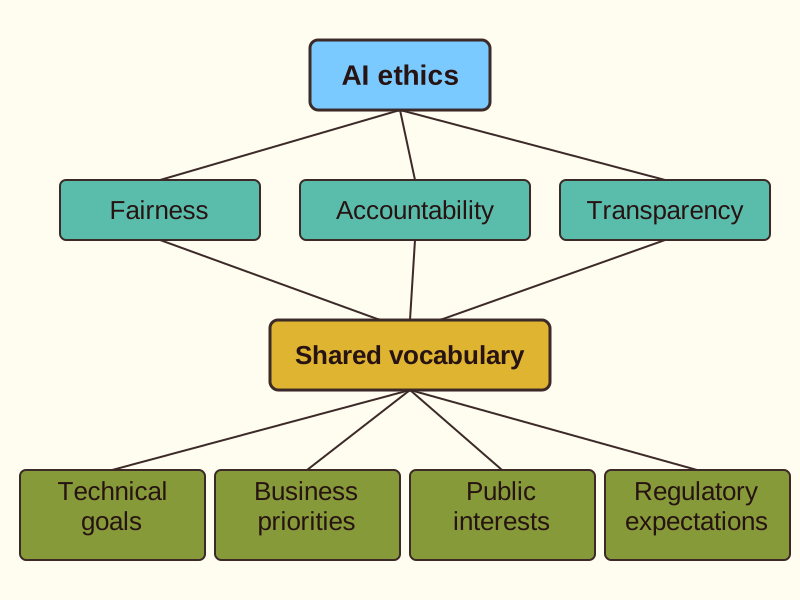
The core pillars are fairness, accountability, and transparency.
Together, they create a shared vocabulary for discussing risks, responsibilities, and values.
This vocabulary helps teams align technical goals with business priorities, public interests, and regulatory expectations.
Fairness and Algorithmic Bias
Fairness means actively considering whether an AI system produces biased outcomes.
For example, a team deploying an automated business process should ask whether its results disadvantage certain people or groups.
Fairness does not happen automatically because a system uses data or follows consistent rules.
Teams must examine how algorithmic decisions affect users and identify risks early.
Developers, product managers, and policy experts can then work together to reduce bias while supporting legitimate organizational goals.
- Ask: Ask whether the AI system’s results disadvantage certain people or groups.
- Examine: Examine how algorithmic decisions affect users.
- Identify: Identify potential risks early rather than assuming consistent rules guarantee fairness.
- Reduce: Bring developers, product managers, and policy experts together to reduce bias while supporting legitimate organizational goals.
Accountability When Systems Fail
Accountability defines who is responsible when an AI system fails or causes harm.
Responsibility should not disappear behind technical complexity or automated decisions.
Organizations need clear ownership across development, product management, deployment, and policy functions.
When a system produces a harmful outcome, teams should be able to identify who reviews the failure and who acts next.
This clarity supports responsible deployment and helps organizations respond before an ethical problem becomes a legal or reputational crisis.
Transparency Builds Understanding
Transparency helps stakeholders understand how an AI system reaches decisions.
This matters especially when a black-box model makes decisions that people cannot easily interpret.
Explainable processes help users, leaders, regulators, and internal teams evaluate whether a system operates consistently with organizational values.
Transparency does not require every stakeholder to understand technical code.
It requires useful explanations about the decision process, relevant risks, and the people responsible for oversight.
- Black-box model
- Explainable process
Putting Principles Into Practice
The three pillars work together as a practical compass for corporate AI deployment.
Fairness helps teams identify bias. Accountability clarifies ownership. Transparency supports meaningful explanations.
A cross-functional approach brings developers, product managers, and policy experts into the same conversation.
Together, they can connect technical choices with business objectives and the public good.
This alignment strengthens trust with users and regulatory bodies while helping teams identify ethical risks before they escalate.

Core Principles at a Glance
Check yourself
Does an AI system become fair automatically when it uses data and follows consistent rules?
- No
- Yes
Answer: No
No. Fairness does not happen automatically because an AI system uses data or applies consistent rules. Teams must examine outcomes and identify whether particular people or groups may be disadvantaged.
In corporate AI deployment, _____ examines biased outcomes, _____ assigns responsibility for failures, and _____ provides explanations of decisions.
Answer: In corporate AI deployment, fairness examines biased outcomes, accountability assigns responsibility for failures, and transparency provides explanations of decisions.
Each pillar has a distinct role: fairness examines biased outcomes, accountability assigns responsibility for failures, and transparency supports explanations of decisions.
A company’s automated business process produces a harmful outcome. Which response best demonstrates accountability?
- The system itself is responsible
- The organization assigns clear ownership across relevant functions
- No one is responsible when automation is involved
- Only the end user is responsible
Answer: The organization assigns clear ownership across relevant functions
Accountability means the organization can identify who reviews a harmful outcome and who acts next. Technical complexity or automation should not make responsibility disappear.
Keep going
This is lesson 1 of 4 in AI Ethics for Organizational Awareness. Next up:
- Algorithmic Bias
- Policy Frameworks
- Accountability Models
Wondering turns any topic into short lessons you can read, watch, or listen to, with practice questions and an AI tutor.