Free sample lesson · AI Code Review at Scale: Lessons from LinkedIn
Why multi-agent consensus beats a single model
Lesson 1 of the Wondering course AI Code Review at Scale: Lessons from LinkedIn
One Reviewer Is Not Enough
A single model reviewing a pull request is one opinion.
It can miss a real bug. It can also flag something harmless with total confidence.
Multi-agent review answers this differently. Several specialized agents read the same PR independently, and their agreement becomes the signal.
No single model is trusted alone.
- Single model
- Multi-agent
Specialized Agents, Same PR
Each agent is specialized. One focuses on its own review angle, another on a different one.
They all read the same pull request.
That shared input matters. Because the code under review is identical, any difference in findings comes from the reviewers, not from the material.
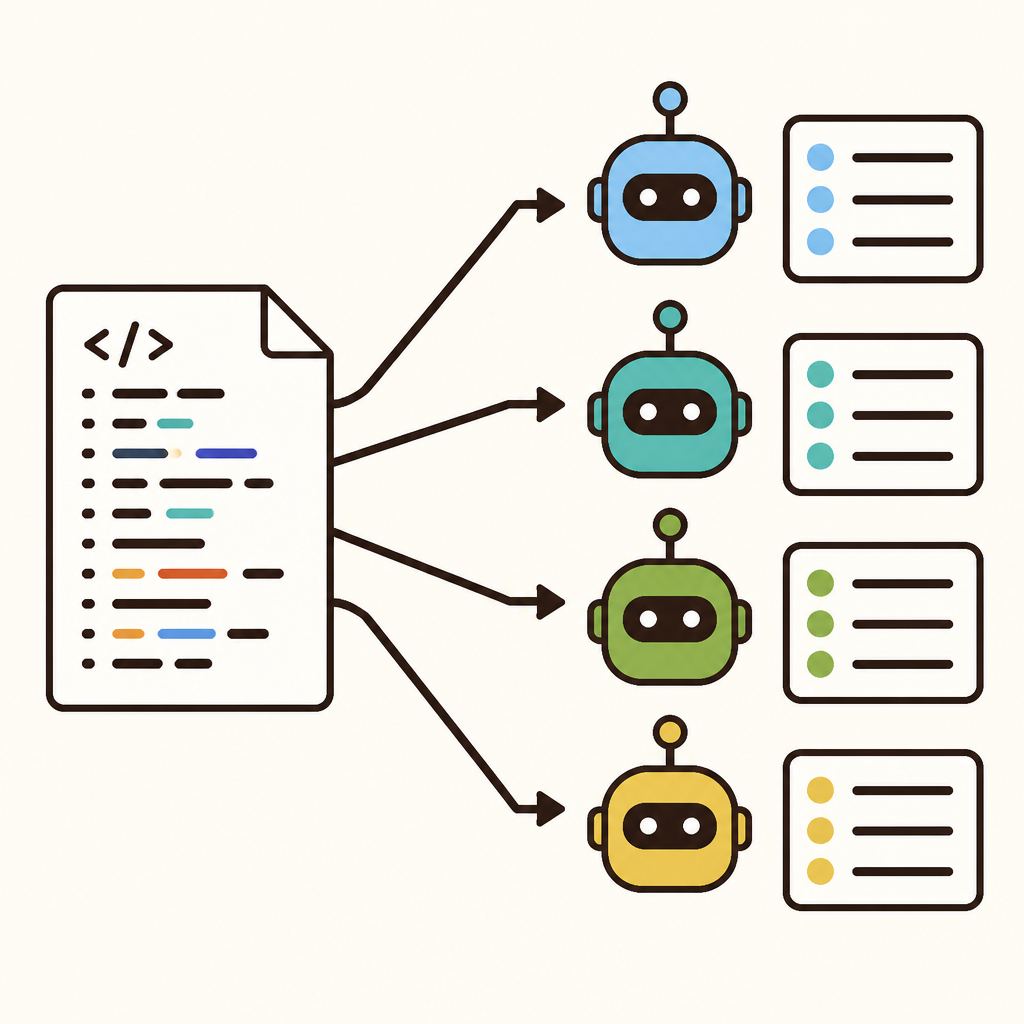
Notice that every agent receives the identical pull request, so any difference in their findings comes from the reviewers themselves.
Independence Is the Point
The agents review independently.
They do not see each other's findings first. That keeps one agent's mistake from spreading to the rest.
If agents copied one another, agreement would mean nothing. Independence is what makes overlap informative.
Overlap Means High Confidence
Now the interesting part.
When two or more agents independently flag the same thing, that finding is treated as a high-confidence signal.
Overlap is the consensus rule. A finding raised by several separate reviewers is far more likely to be real than one raised alone.
- Same PR: Every specialized agent receives the identical pull request.
- Review alone: Each agent produces its findings independently of the others.
- Compare findings: Findings from all agents are lined up against each other.
- Mark overlap: Findings raised by several agents become high-confidence signals.
Cutting Down False Positives
A false positive is a flagged issue that is not actually a problem.
One model alone produces plenty of them, and every one costs a developer time.
Consensus filters these out. A quirk of a single agent rarely survives comparison, because the other agents did not raise it.
- Treated as high-confidence signal
- Likely a real problem
- Likely a false positive
- Did not survive comparison
- One opinion trusted alone
- Costs developer time when wrong
Putting It to Work
Treat no single model as the final word on a PR.
Run specialized agents over the same code, keep their reviews separate, then look at where the findings overlap.
Overlap is your priority list. Lone flags deserve a second look before anyone acts on them.
Check yourself
Does one model's confident review guarantee that every flagged issue is a real problem?
- Yes
- No
Answer: No
No. A single model can miss genuine bugs and confidently report harmless code as a problem.
In multi-agent review, a flagged issue that is not actually a problem is a _____; a finding raised by several reviewers is _____; and agreement among reviewers forms the _____ signal.
Answer: In multi-agent review, a flagged issue that is not actually a problem is a false positive; a finding raised by several reviewers is overlap; and agreement among reviewers forms the consensus signal.
A false positive is an incorrect issue report. Overlap identifies findings shared by multiple reviewers, and consensus uses that agreement as a signal.
Why is it important for several specialized agents to inspect the same pull request?
- It ensures every agent sees identical code, making reviewer agreement meaningful.
- It lets each agent choose different code so more files are covered.
- It allows the first agent to teach the others what to report.
- It guarantees that every agent will identify the same issues.
Answer: It ensures every agent sees identical code, making reviewer agreement meaningful.
Because the code is identical for every reviewer, differences in findings reflect differences among the reviewers rather than differences in the material examined.
Keep going
This is lesson 1 of 5 in AI Code Review at Scale: Lessons from LinkedIn. Next up:
- The 3-tier context framework
- Acceptance rates vary sharply by category
- Two-sided evaluation: pre-merge and post-merge
- Production infrastructure, not a prototype
Wondering turns any topic into short lessons you can read, watch, or listen to, with practice questions and an AI tutor.