Free sample lesson · Advanced Product Design Mastery
Root Problems
Why do most requested features fail to fix the underlying user friction?
Lesson 1 of the Wondering course Advanced Product Design Mastery
The Request Is Not the Problem
A stakeholder asks for a filter. A user asks for a bulk export button.
Both requests describe a symptom, not a cause.
For a senior designer, mastery is no longer in the high-fidelity prototype. It sits in the ruthless interrogation of the problem space.
Every request is a hypothesis someone else already closed. Your job is to reopen it.
Friction Has a Location
User friction always sits somewhere specific in a workflow.
The requested feature usually sits somewhere else, downstream, where the pain finally becomes visible.
Deconstructing the workflow means walking each step until you find where the structure, not the interface, breaks.
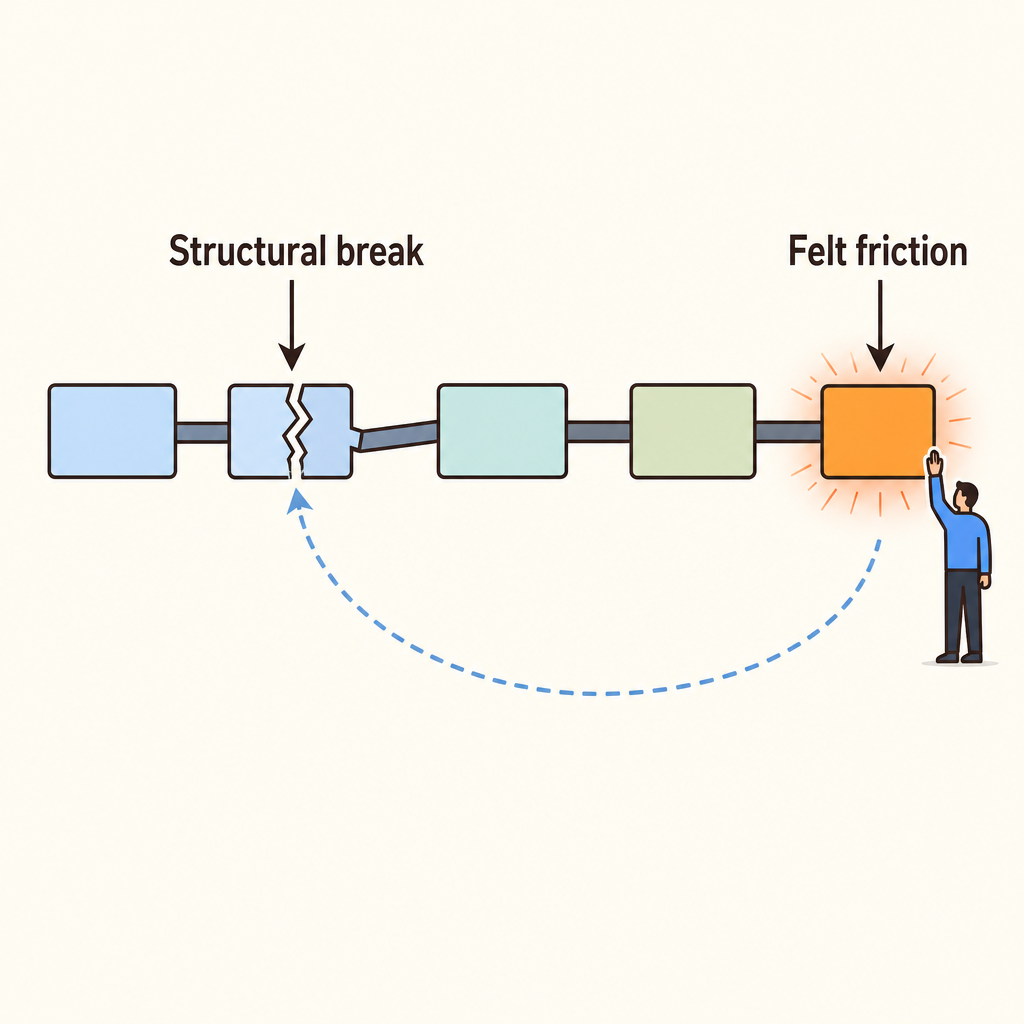
Notice that the point where the user asks for a feature sits far downstream from the place where the workflow structure actually breaks.
That gap between where pain shows and where pain starts is the whole discipline.
Band-Aid or Architecture
Test every proposed solution against one question: does it remove the cause or hide it?
A band-aid absorbs the symptom and leaves the architecture untouched. The friction returns wearing a different face next quarter.
An architectural fix changes the structure so the symptom has nowhere to form.
- Band-aid
- Architectural fix
Both ship. Only one reduces the number of future requests.
Interactions Ripple
Product judgment at this level requires seeing how one interaction ripples across the whole ecosystem.
A single control does not stay local. It touches the data model, adjacent flows, support load, and the design system itself.
This is why adding the requested feature can quietly raise the cost of every future decision.
- Data model: A single control does not stay local.
- Adjacent flows
- Support load
- Design system
- Future decisions: Added features quietly raise the cost of every future decision.
Systems thinking means tracing those ripples before, not after, the build.
From What to Why
The shift is small in wording and large in consequence.
Stop asking what should we build. Start asking why does this friction exist.
The first question makes you a service provider taking orders. The second makes you a strategic partner shaping the order.
- Service provider
- Strategic partner
Same stakeholder, same meeting, different position in the conversation.
Deconstructing a Request
First principles deconstruction is a repeatable move, not an instinct.
You take the request apart until only the fundamental user and business need remains.
Then you rebuild upward from that need, which may or may not produce the requested feature.
- Capture request: Record the requested feature exactly as the stakeholder framed it.
- Map workflow: Deconstruct the user's workflow step by step to locate where friction starts.
- Name cause: State whether the friction is an interface issue or an architectural flaw.
- Trace ripples: Check how the interaction affects the wider product ecosystem.
- Define problem: Restate the fundamental user and business need the work must serve.
Evidence Moves Executives
Interrogating the problem is only half the work. The other half is being believed.
Executives do not change direction because a designer disagrees with a request.
They change direction when they see data-backed evidence about long-term product health.
Bring the workflow findings, the ripple analysis, and the cost of the band-aid. Opinion alone loses to a roadmap.
- Evidence
- Workflow findings: Shows where friction actually begins in the user's steps.
- Ripple analysis: Shows how one interaction touches the wider ecosystem.
- Cost of the band-aid: Shows what the symptom-level fix leaves unresolved.
- Argument
- Long-term product health: The frame executives can act on.
- Not short-term feature bloat: The outcome the evidence is meant to prevent.
Opinion alone loses to a roadmap.
The Bloat Trap
Every unexamined request adds surface area.
Short-term feature bloat feels like responsiveness. It is accumulated debt in the product ecosystem.
The misconception is that saying yes builds trust. Repeatedly shipping band-aids builds a product nobody can navigate.
- Request arrives: A stakeholder names a specific feature.
- Ship band-aid: The symptom is absorbed and the architecture is untouched.
- Surface area grows: Every unexamined request adds more product surface.
- New friction forms: The product becomes harder to navigate.
- New request arrives: The friction returns wearing a different face.
Long-term product health is the counterweight you argue for.
Judgment in Practice
This is the move from tactical execution to strategic problem definition.
You already own craft. Craft applied to the wrong problem is expensive.
Ask why the friction exists. Trace it through the ecosystem. Bring evidence about long-term health.
Then every design intervention you ship serves a fundamental business and user need.
Check yourself
A request for a bulk export button should initially be treated as a symptom description rather than a confirmed root cause.
- True
- False
Answer: True
Feature requests usually describe where pain becomes visible, not why the workflow is failing. The designer should investigate the underlying cause before accepting the requested solution.
A _____ hides a symptom while leaving the product structure unchanged. An _____ changes the structure so the symptom has nowhere to form.
Answer: A band-aid hides a symptom while leaving the product structure unchanged. An architectural fix changes the structure so the symptom has nowhere to form.
A band-aid may relieve immediate pain, but the underlying friction can return in another form. An architectural fix addresses the structure that creates the friction.
A team wants to add a filter because users struggle to find records. What is the strongest next step for a designer practicing first-principles deconstruction?
- Prototype the filter immediately
- Walk the workflow to locate where the friction begins
- Add more filter categories to cover edge cases
- Ask the stakeholder to rank the requested filter options
Answer: Walk the workflow to locate where the friction begins
The designer should walk the workflow to find where its structure breaks. The filter may help at the visible pain point, but the underlying issue could be poor data organization, an earlier capture problem, or another systemic failure.
Keep going
This is lesson 1 of 37 in Advanced Product Design Mastery. Next up:
- Simplicity Traps
- Ripple Effects
- Opportunity Mapping
- Constraint Modeling
- Strategic Moats
Wondering turns any topic into short lessons you can read, watch, or listen to, with practice questions and an AI tutor.