Free sample lesson · Advanced Praxeology and Political Philosophy
Human Action
Can a science of economics be built entirely on the fact that humans act with purpose?
Lesson 1 of the Wondering course Advanced Praxeology and Political Philosophy
The Foundation of Human Action
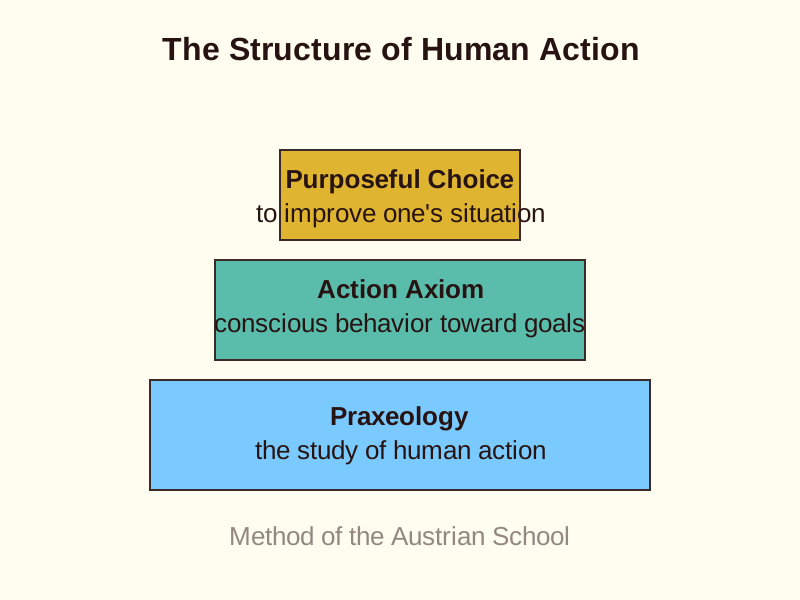
Praxeology is the unique method used by the Austrian School of economics. It focuses on the study of human action.
At its center is the action axiom. This is the truth that human beings engage in conscious behavior to reach specific goals.
Action is not just a reflex. It is a purposeful choice made by an individual to improve their situation.
A Logical Necessity
The action axiom is more than a simple observation. It is a logical necessity.
To argue against the fact that humans act is, in itself, a purposeful action. You must use means and logic to try to reach the end of proving your point.
Because of this, the axiom cannot be denied without creating a logical contradiction.
- Action Axiom
- Denying Action
Deduction Over Data
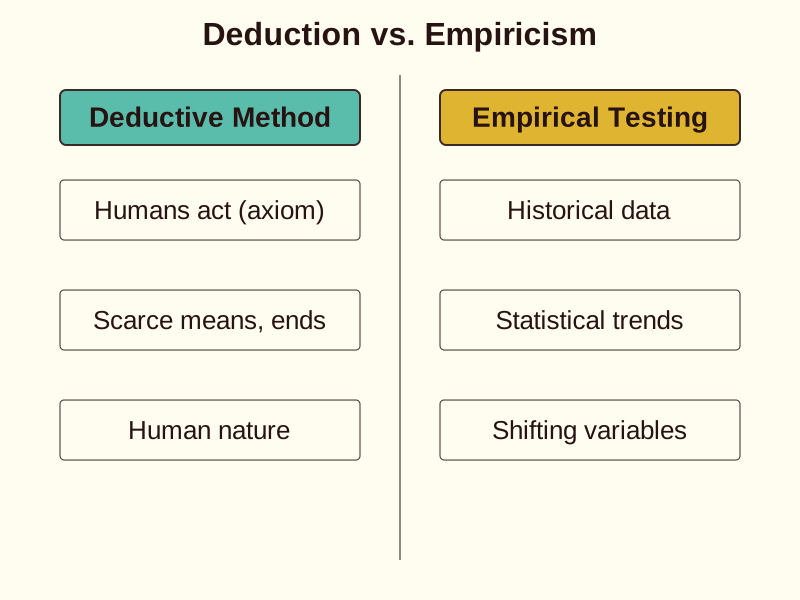
Austrian economics derives laws through deduction rather than empirical testing. This process starts with the fact that humans act.
By recognizing that individuals use scarce means to satisfy their most valued ends, we can understand choice and value.
This approach ensures theory stays grounded in human nature. It does not rely on the shifting trends of historical data.
Applying the Framework
Understanding human action provides a rigorous framework for analyzing markets. It helps us see the nature of time preference and social interaction.
This deductive method allows for consistent logical arguments in policy debates.
By starting with the individual, we can better understand complex economic phenomena without losing sight of reality.
Putting It All Together
- Identify Actor: Isolate the individual human beings acting toward chosen goals.
- Examine Means: Recognize the use of scarce means to satisfy valued ends.
- Deduce Outcome: Apply logical deduction rather than historical correlation to find consequences.
Check yourself
In praxeology, human action is defined as _____ behavior aimed at achieving chosen goals.
- conscious
- reflexive
Answer: conscious
Human action in praxeology is defined specifically as conscious, purposeful choice to improve one's situation, rather than an involuntary reflex.
In Austrian economics, _____ derives laws from the action axiom, whereas _____ relies on historical data.
Answer: In Austrian economics, deduction derives laws from the action axiom, whereas empirical testing relies on historical data.
Austrian economics bases its principles on logical deduction from the truth that humans act, rather than relying on empirical testing of historical trends.
Why is attempting to argue against the action axiom considered a logical contradiction?
- The act of arguing itself requires using purposeful means to reach a chosen end.
- Historical data proves that no one can successfully refute economic axioms.
- Reflexive biological behaviors automatically override logical reasoning during debates.
- It relies on empirical measurements that contradict theoretical predictions.
Answer: The act of arguing itself requires using purposeful means to reach a chosen end.
To argue against the action axiom, an individual must purposefully choose means (arguments and logic) to reach an end (proving a point), which itself is a purposeful human action.
Keep going
This is lesson 1 of 6 in Advanced Praxeology and Political Philosophy. Next up:
- Subjective Value
- Self-Ownership
- Non-Aggression
- Interventionism Critique
- Monetary Theory
Wondering turns any topic into short lessons you can read, watch, or listen to, with practice questions and an AI tutor.