Free sample lesson · A Theory of Fun for Game Design
Fun as Need
Why do you feel guilty when you're playing games instead of working?
Lesson 1 of the Wondering course A Theory of Fun for Game Design
Why Play Feels Guilty
You finish a game and feel a small pang of guilt. You were supposed to be working.
Many of us treat fun as a guilty pleasure: a treat we earn only after the serious work is done.
This lesson argues the opposite. Fun is core to being human, and it is closely tied to how we learn and develop.
- Guilty pleasure
- Core human need
Children Learn by Playing
Watch a young child and you will see learning happen fast.
Children master extraordinarily complex skills, like language, without formal lessons. They pick it up instinctively through game-like exploration.
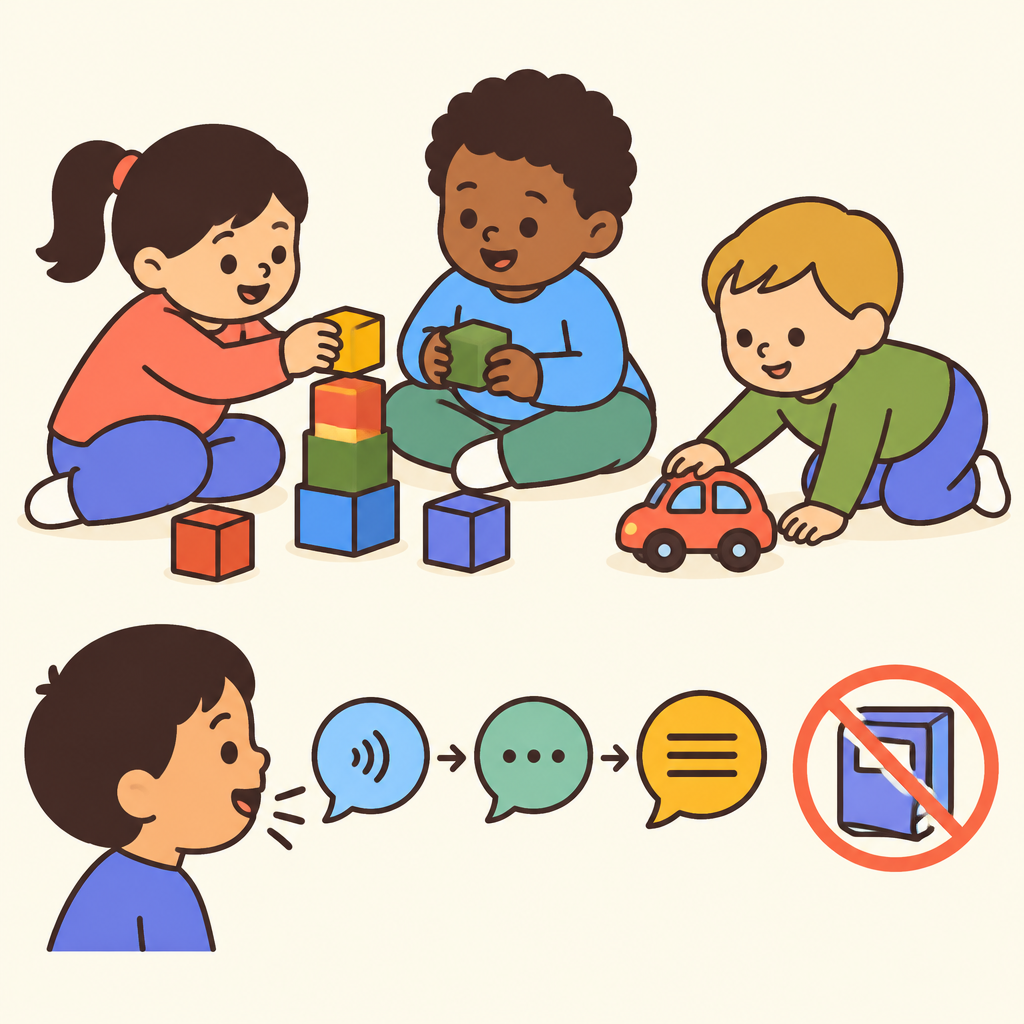
Play is how young children explore and learn
No one hands a toddler a grammar textbook.
They try sounds, test words, and see what works. This is strong evidence that fun and learning belong together.
A Safe Place to Fail
Games give you a consequence-free environment.
In a game, a bad move breaks nothing in your real life. No lost money, no damaged reputation, no real-world penalty.
That safety matters. Without anxiety, you are free to try a bold idea, see what happens, and adjust your approach.
Then you try again. This repeating cycle is where much of the learning happens.
- Try a bold idea: No real penalty makes risk easier.
- See what happens: The game shows the result right away.
- Adjust your approach: Use what you saw for the next attempt.
Growing Minds and Relationships
Games are more than diversions. They contribute to two kinds of human growth.
Cognitive development: games stretch how we think, explore, and solve problems.
Social development: playing with others shapes how we cooperate and follow shared rules.
- Learning through games
- Cognitive development: Stretches how we think, explore, and solve problems.
- Social development: Shapes how we cooperate and follow shared rules.
Both kinds of growth happen while the player is simply having fun.
A Medium Worth Taking Seriously
If games teach this well, they deserve serious attention.
Two claims follow. Games are a valuable educational tool, and the gaming medium is a potential art form.
Neither idea fits the picture of games as wasted time.
Taking games seriously does not mean every game is great. It means the medium is worth studying, designing well, and judging on its merits.
Putting the Idea to Work
So what do you do with this idea?
Notice the guilt. When play feels wrong, ask whether you are actually learning something.
Reframe fun. Tell a colleague plainly: fun is a human need that drives learning, not a reward for finished work.
Use games on purpose. Treat them as low-risk spaces to practice skills before the stakes are real.
- Notice: Catch the guilt and ask what you are learning.
- Reframe: Describe fun as a human need tied to learning.
- Use: Practice skills in games where mistakes cost nothing.
Check yourself
Fun is best understood as _____
- a fundamental human need
- an optional guilty pleasure
Answer: a fundamental human need
Fun is not a luxury or guilty pleasure. It is core to being human and is tied to learning and cognitive development.
How do young children master extraordinarily complex skills such as language?
- Instinctively, through playful, game-like exploration
- Mainly through formal drills and memorization
- Only after they stop playing and focus seriously
- Through fear of real-world penalties for mistakes
Answer: Instinctively, through playful, game-like exploration
Children learn rapidly through play. They pick up complex skills like language instinctively through game-like exploration, not mainly through formal drills or pressure.
Are games mainly just diversions with little value for development?
- Yes
- No
Answer: No
No. Games are valuable learning instruments that contribute to both cognitive and social development, not just ways to pass the time.
Keep going
This is lesson 1 of 49 in A Theory of Fun for Game Design. Next up:
- Evolution & Learning
- Pattern Recognition
- Pattern Learning
- Chunking
- Skill Automation
Wondering turns any topic into short lessons you can read, watch, or listen to, with practice questions and an AI tutor.