Free sample lesson · A Little History of Philosophy
Socratic Method
What if the wisest person is the one who admits they know nothing?
Lesson 1 of the Wondering course A Little History of Philosophy
The Wisdom of Knowing Nothing
Socrates was a philosopher in Athens between 469 and 399 BCE. He believed that most people live with false certainty.
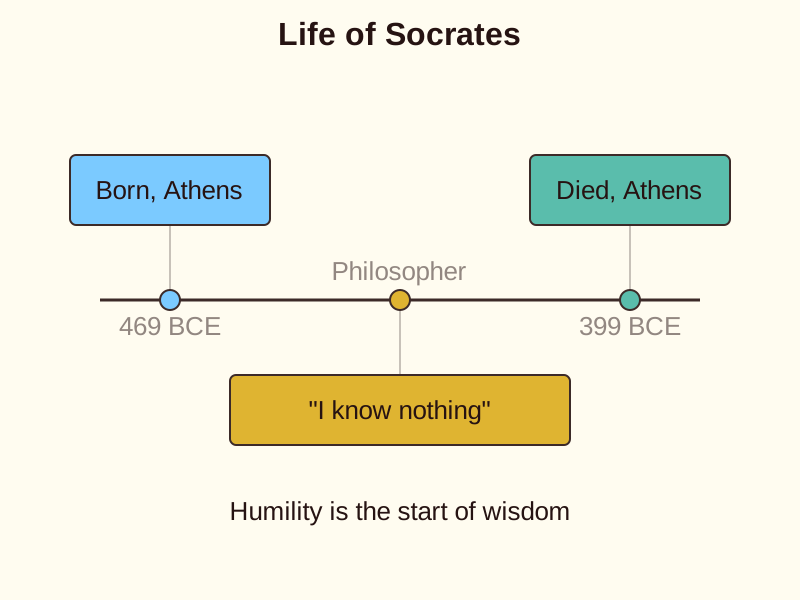
He famously claimed, "I know that I know nothing."
This statement is the starting point of true wisdom. It means you are open to learning because you recognize your own limitations.
Questioning the Experts
Socrates did not give lectures. Instead, he walked through the marketplace and questioned people who seemed wise.
He spoke with politicians, poets, and craftsmen. He asked them to define big ideas like justice or courage.
By asking simple questions, he showed that their confident definitions were often shallow or full of errors.
How the Socratic Method Works
The Socratic Method is a way of thinking through systematic questioning.
You start with a definition and then look for contradictions. If a definition fails a test, you must refine it.
- Propose Definition: Start with a seemingly confident statement or definition of a concept.
- Test & Question: Ask probing questions to find exceptions, edge cases, or contradictions.
- Refine Belief: Discard false certainty and revise the definition based on the new insights.
This process strips away false beliefs. It forces you to think critically about what you actually understand.
The Goal of Inquiry
Socrates shifted philosophy from studying nature to investigating human values.
His goal was not to win arguments. He wanted to help people achieve intellectual humility.
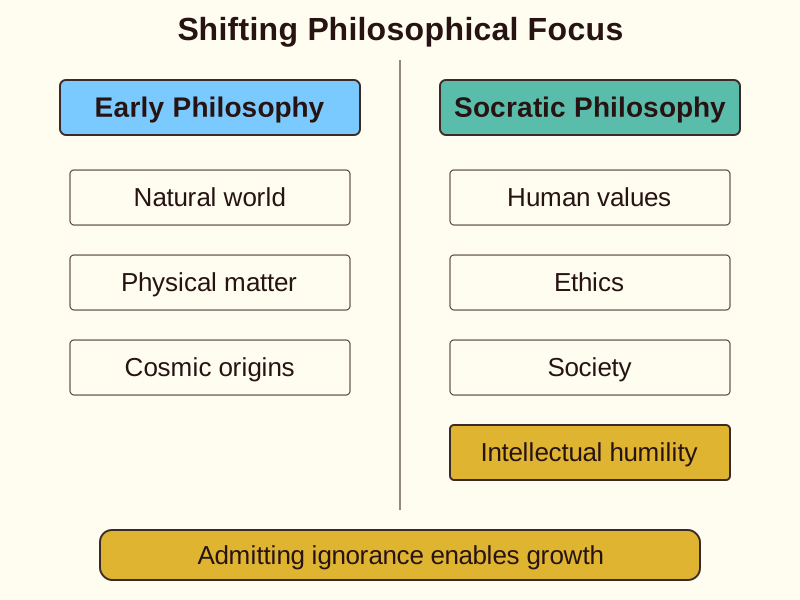
By admitting ignorance, you clear the path for genuine growth. This method remains the foundation for how we study ethics and society today.
How to Apply It in Real Life
- Identify Assumption: Pinpoint a belief you currently hold with absolute certainty.
- Test Through Questioning: Ask what evidence actually supports this belief and where it might fail.
- Embrace Ignorance: Admit what you do not know to open yourself up to genuine learning.
Check yourself
Socrates claimed "I know that I know nothing" in order to demonstrate _____.
- intellectual humility
- false certainty
Answer: intellectual humility
Socrates stated that recognizing one's own limitations opens the path to true learning, cultivating intellectual humility rather than false certainty.
In Socratic philosophy, _____ refers to holding confident beliefs that are shallow or full of errors, whereas _____ is achieved by recognizing one's own ignorance to allow genuine growth.
Answer: In Socratic philosophy, false certainty refers to holding confident beliefs that are shallow or full of errors, whereas intellectual humility is achieved by recognizing one's own ignorance to allow genuine growth.
False certainty occurs when people confidently defend unexamined assumptions. Intellectual humility begins when one acknowledges their lack of knowledge.
What is the main technique used in the Socratic Method to strip away false beliefs?
- Exposing contradictions through systematic questioning
- Delivering formal lectures to explain complex values
- Studying nature and physical phenomena directly
- Winning debates using rhetorical persuasion
Answer: Exposing contradictions through systematic questioning
The Socratic Method uses systematic questioning to expose contradictions in proposed definitions, forcing critical thinking and refinement.
Keep going
This is lesson 1 of 44 in A Little History of Philosophy. Next up:
- Examined Life
- The Examined Life: Depth and Virtue
- Human Flourishing
- Golden Mean
- Skepticism
Wondering turns any topic into short lessons you can read, watch, or listen to, with practice questions and an AI tutor.