An introduction to math: its history, main branches, and how to understand it
Math is the study of patterns, quantity, shape, and structure, built on proof: a chain of reasoning that shows a statement must be true. It began with counting and measuring in Babylon and Egypt about 4,000 years ago, became a science of proof with the Greeks and Euclid, gained zero and place value in India and algebra in Baghdad, and grew calculus, set theory, and logic in Europe. Its main branches are number theory, algebra, geometry and topology, analysis, probability and statistics, discrete math, and logic. To understand it, work problems instead of only reading, build from prerequisites, expect to struggle, and explain each step in your own words. Wondering teaches math in 3-minute lessons with practice after each one, spaced review, and a voice tutor. It is free to start.
| Branch | What it studies | Key ideas | Where it shows up |
|---|---|---|---|
| Arithmetic and number theory | Whole numbers and their properties | Primes, divisibility, modular arithmetic | Encryption, check digits, computer science |
| Algebra | Symbols, equations, and structures | Variables, equations, groups, vectors | Every field that uses formulas, physics, graphics |
| Geometry and topology | Shape, size, space, and what survives stretching | Proof from axioms, curvature, surfaces | Maps, architecture, GPS, relativity |
| Analysis and calculus | Change, limits, and the infinite | Derivatives, integrals, series | Physics, engineering, economics, machine learning |
| Probability and statistics | Chance and learning from data | Random variables, distributions, inference | Medicine, polling, insurance, AI |
| Discrete math | Countable things: graphs, networks, choices | Graphs, counting, recursion | Algorithms, routing, scheduling |
| Logic and foundations | What a proof is and what can be proved | Sets, axioms, computability | Programming languages, proof checkers |
What is math?
Math is the study of patterns and structure. It asks what is true about numbers, shapes, change, chance, and the relations between them. Its tools are definitions, symbols, and above all proof.
A proof is a chain of steps that shows a statement must be true, not just that it looks true in a few cases. You can check that 1 + 3 = 4, 1 + 3 + 5 = 9, and 1 + 3 + 5 + 7 = 16, and guess that adding the first n odd numbers always gives n squared. A proof shows it holds for every n, forever.
That is what makes math unusual. A result proved by Euclid around 300 BCE is still true today. Science revises its theories as new evidence arrives, but a correct proof does not expire.
The British mathematician G. H. Hardy wrote in A Mathematician's Apology (1940) that "a mathematician, like a painter or a poet, is a maker of patterns." Whether you call it math or maths, as people do in the UK, the subject is the same: finding patterns and proving why they hold.
The first mathematics: Babylon and Egypt
The oldest written math comes from Mesopotamia, in what is now Iraq. Babylonian scribes wrote on clay tablets and counted in base 60. We still live with that choice: 60 seconds in a minute, 60 minutes in an hour, and 360 degrees in a circle.
Babylonian math was practical and impressive. Scribes solved problems we would now call quadratic equations, computed areas of fields, and worked out interest on loans. One tablet, YBC 7289, gives the square root of 2 correct to about six decimal places.
Egypt had its own tradition. The Rhind Papyrus, copied by a scribe named Ahmes around 1550 BCE, is a set of worked problems on fractions, areas, volumes, and dividing bread among workers. Egyptians wrote fractions as sums of unit fractions, like 1/2 + 1/4 for three quarters.
What these cultures mostly did not do was prove things in general. They had reliable methods and many worked examples. The idea that every claim needs a proof came later.

Greek proof and Euclid's Elements
Greek thinkers changed the question from "how do you compute this?" to "why is this true?" Thales and the followers of Pythagoras, in the 500s BCE, are traditionally credited with the first proofs, though little of their work survives directly.
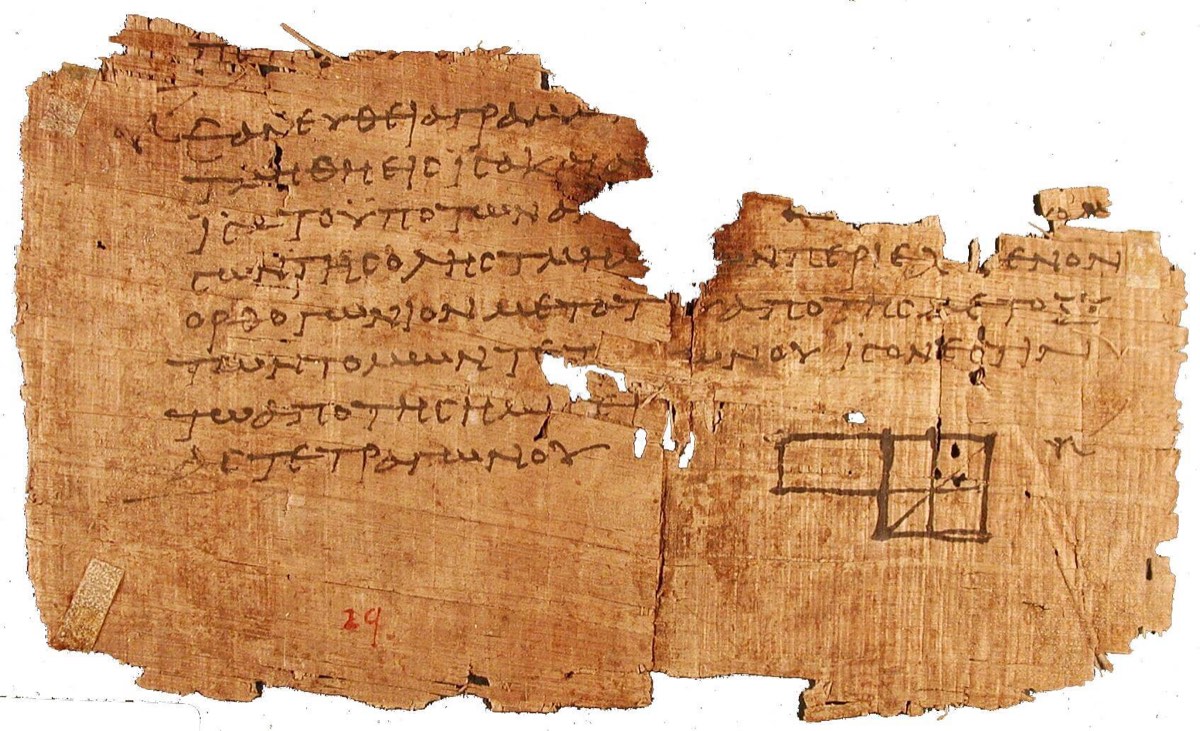
Around 300 BCE, Euclid of Alexandria wrote the Elements, 13 books that start from a few definitions, postulates, and common notions and derive hundreds of results from them, one step at a time. Book IX contains a proof that there are infinitely many prime numbers, still one of the most elegant arguments in math.
The Elements became the model of rigorous thinking for over 2,000 years. It was used as a geometry textbook into the 1900s, and thinkers from Newton to Lincoln studied it to learn how to reason.
Other Greeks pushed further. Archimedes (about 287 to 212 BCE) trapped pi between 3 10/71 and 3 1/7 using polygons with 96 sides, and found areas and volumes with methods close to calculus. Later, Diophantus studied equations with whole-number solutions, a field that still bears his name.

Zero, place value, and algebra: India and Baghdad
The numbers you write every day come from India. Indian mathematicians developed a place-value system with ten digits, where the position of a digit sets its value. In 628, Brahmagupta treated zero as a number in its own right and gave rules for adding, subtracting, and multiplying with zero and with negative numbers.
This sounds small, but it changed everything. Try multiplying 347 by 58 in Roman numerals, CCCXLVII times LVIII, and you will see why. Place value turned arithmetic into something anyone could learn with pen and paper.
In Baghdad, around 820, the scholar Muhammad ibn Musa al-Khwarizmi wrote a book on solving equations by "al-jabr", moving terms from one side to the other. That word became "algebra". His name, turned into Latin, gave us the word "algorithm".
Scholars in the Islamic world also translated and preserved Greek works, including Euclid, and extended them. Omar Khayyam, better known in the West as a poet, solved cubic equations using geometry.
Europe catches up: Fibonacci, Descartes, and calculus
In 1202, Leonardo of Pisa, later called Fibonacci, published Liber Abaci. It taught European merchants the Hindu-Arabic numerals he had learned while traveling in North Africa. The book also contains a puzzle about breeding rabbits that produces the sequence 1, 1, 2, 3, 5, 8, 13, now named after him.
In 1637, René Descartes published La Géométrie, which joined algebra and geometry. With coordinates, a circle becomes an equation like x² + y² = 1, and an equation becomes a curve you can draw. Pierre de Fermat had similar ideas around the same time.
Calculus came next. Isaac Newton and Gottfried Wilhelm Leibniz developed it independently in the late 1600s, which led to a bitter dispute over who came first. Calculus gave two tools: the derivative, which measures how fast something changes, and the integral, which adds up infinitely many tiny pieces.
With calculus, Newton could explain the orbits of planets and the fall of an apple with the same law. Most of physics and engineering since then is written in its language. Leibniz's notation, like dy/dx, is the one students still use.
Euler, Gauss, and new geometries
Leonhard Euler (1707 to 1783) was one of the most productive mathematicians who ever lived. He gave us much of our notation, including f(x) for a function and i for the square root of -1. In 1736 he solved the puzzle of the seven bridges of Königsberg, showing there was no walk crossing each bridge exactly once, and founded graph theory.
Carl Friedrich Gauss (1777 to 1855) worked across number theory, geometry, statistics, and physics. His Disquisitiones Arithmeticae (1801) organized number theory into a modern field. The bell-shaped normal distribution is often called the Gaussian in his honor.
For 2,000 years, mathematicians tried to prove Euclid's fifth postulate, about parallel lines, from his other assumptions. In the 1820s and 1830s, Nikolai Lobachevsky and János Bolyai showed you could replace it and still get a consistent geometry, one where the angles of a triangle add up to less than 180 degrees.
This was a shock. It meant axioms are choices, not obvious truths. Bernhard Riemann generalized these ideas to curved spaces in 1854, and about 60 years later Einstein used Riemann's geometry to describe gravity in general relativity.
Foundations: Cantor, Hilbert, Gödel, and Turing
In the 1870s, Georg Cantor began studying sets, collections of objects, and proved that some infinities are bigger than others. There are as many even numbers as whole numbers, but there are strictly more real numbers than whole numbers. Many of his contemporaries resisted the idea.
Set theory soon became the common language of math, but it also produced paradoxes. Bertrand Russell found one in 1901: the set of all sets that do not contain themselves both must and cannot contain itself. Mathematicians wanted firm foundations.
In 1900, David Hilbert presented a famous list of 23 open problems in Paris, and later he proposed a program to put all of math on a complete and consistent set of axioms. In 1931, Kurt Gödel showed this was impossible: any consistent system strong enough for basic arithmetic contains true statements it cannot prove.
In 1936, Alan Turing defined computation with an imaginary machine and proved that no algorithm can decide, for every program, whether it will ever stop. His paper, written to answer a question in logic, laid the groundwork for computer science.
Turning points in math
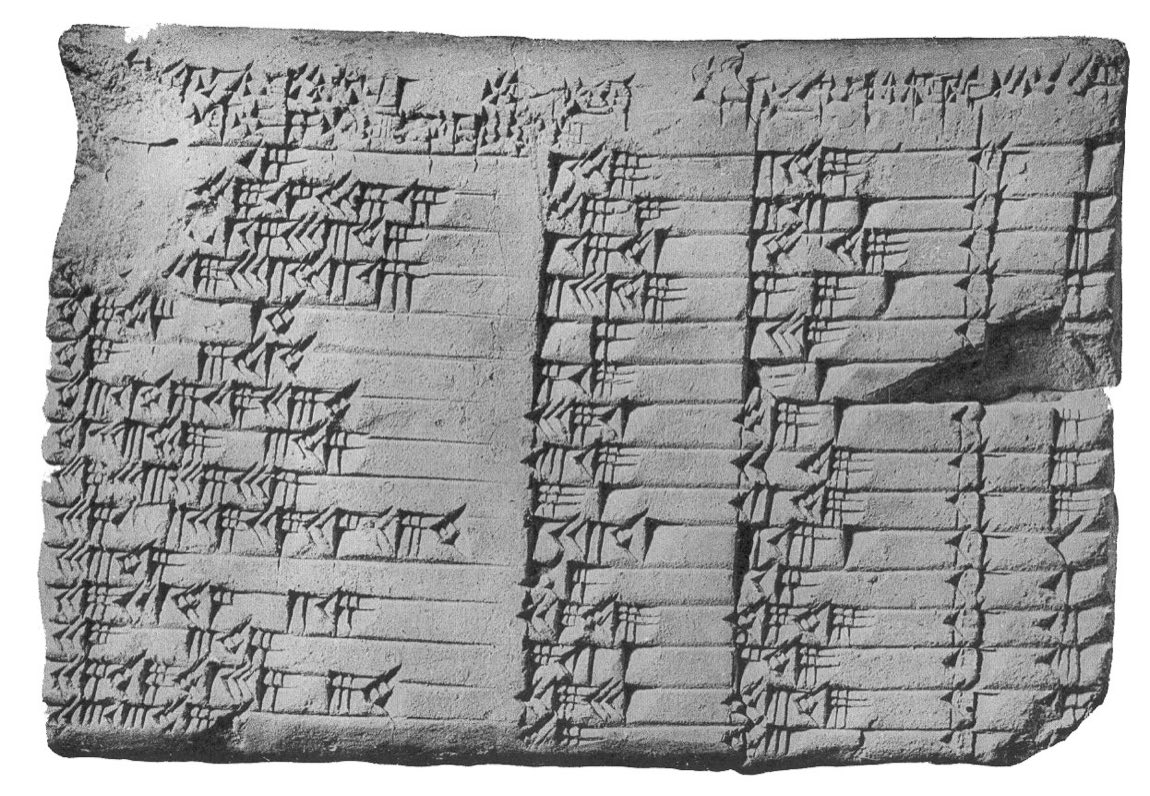
- c. 1800 BCE: Plimpton 322: Babylonian tablet of base-60 numbers linked to right triangles.
- c. 300 BCE: Euclid's Elements: Geometry built from a few axioms by step-by-step proof.
- 628: Zero as number: Brahmagupta gives rules for arithmetic with zero and negatives.
- c. 820: Algebra: Al-Khwarizmi writes his book on solving equations by al-jabr.
- Late 1600s: Calculus: Newton and Leibniz independently invent the math of change.
- 1874: Set theory: Cantor shows some infinities are larger than others.
- 1931: Gödel's theorems: Any consistent system for arithmetic has unprovable truths.
Is math discovered or invented? Four schools of thought
The crisis in foundations raised an old question: what is math about? Four main answers came out of the late 1800s and early 1900s, and the debate is still open.
Platonism says mathematical objects, like numbers and perfect circles, really exist outside space and time, and we discover them. Gödel was a Platonist. Most working mathematicians talk like Platonists, saying they "found" a proof.
Logicism, led by Gottlob Frege and Bertrand Russell, tried to show that math is just logic in disguise. Whitehead and Russell's Principia Mathematica (1910 to 1913) famously takes hundreds of pages to reach a proof that 1 + 1 = 2. Gödel's results showed the program could not fully succeed.
Formalism, linked to Hilbert, treats math as the manipulation of symbols by fixed rules, where the question is whether results follow from the axioms, not whether they describe some real world. Intuitionism, founded by L. E. J. Brouwer, says math is a construction of the human mind, so you may only claim something exists if you can build it. Intuitionists reject some classical proofs by contradiction about infinite sets.
You do not need to pick a side to learn math. But knowing the debate helps explain why mathematicians care so much about axioms, definitions, and what counts as a proof.
The main branches of math
Modern math has dozens of fields, but most fall under a handful of big branches. They overlap constantly, and many of the deepest results connect two of them, like using algebra to answer questions about geometry.
Arithmetic and number theory study whole numbers, especially primes. Algebra studies equations and the structures behind them. Geometry studies shape and space, and topology studies the properties that survive stretching, which is why a topologist cannot tell a coffee mug from a donut.
Analysis is the rigorous version of calculus, built on limits. Probability studies chance, and statistics uses it to draw conclusions from data. Discrete math covers countable things like graphs and networks, and is the backbone of computer science. Logic studies proof itself.
Mathematicians also split the field into pure math, studied for its own sake, and applied math, built to solve problems in science and industry. The line is blurry. Number theory was once the purest of fields, and it now secures most online payments through encryption.
Branches of math
Number theory
- Primes: Numbers divisible only by 1 and themselves
- Modular arithmetic: Clock-style math behind encryption
Algebra
- Equations: Solving for unknowns
- Linear algebra: Vectors and matrices
- Abstract algebra: Groups, rings, and symmetry
Geometry and topology
- Euclidean geometry: Flat space, proof from axioms
- Differential geometry: Curved spaces, used in relativity
- Topology: Shape under stretching
Analysis
- Calculus: Rates of change and accumulation
- Differential equations: Laws of change in physics and biology
Probability and statistics
- Probability: The math of chance
- Statistics: Drawing conclusions from data
Discrete math
- Graph theory: Networks of points and links
- Combinatorics: Counting arrangements and choices
Logic and foundations
- Set theory: Collections and sizes of infinity
- Computability: What algorithms can and cannot do
Key ideas every beginner needs
A few ideas show up in every branch. Learn them well and the rest of math becomes much easier to follow.
A variable is a name for a number you do not know yet, or for any number in a range. A function is a rule that turns each input into exactly one output, like "double it and add 3". Equations state that two expressions are equal, and solving one means finding the values that make it true.
A definition says exactly what a word means, with no wiggle room. An axiom is a starting assumption you accept without proof. A theorem is a statement proved from definitions and axioms. Much confusion in math comes from using a word without knowing its precise definition.
Finally, there are a few ways to prove things that come up again and again: direct proof, proof by contradiction (assume the opposite and reach something impossible), and proof by induction (show a statement holds for 1, and that if it holds for n it holds for n + 1). Euclid's proof that the primes never run out is a proof by contradiction.
Why math describes the world so well
Functions let you compare how things grow. Linear growth adds the same amount each step. Exponential growth multiplies by the same factor each step. Early on they can look similar, and linear can even be ahead. Then exponential growth leaves it behind.
This one pattern explains compound interest, the early spread of an epidemic, and why a sheet of paper cannot be folded in half many times. People routinely underestimate it, which is a good reason to learn to read a graph.
In 1960, the physicist Eugene Wigner wrote an essay called "The Unreasonable Effectiveness of Mathematics in the Natural Sciences". He asked why ideas mathematicians invent for their own sake, like Riemann's curved geometry or complex numbers, so often turn out to describe nature exactly. Nobody has a full answer.
Linear vs exponential growth
| x | y = 10x | y = 2^x |
|---|---|---|
| 0 | 0 | 1 |
| 1 | 10 | 2 |
| 2 | 20 | 4 |
| 3 | 30 | 8 |
| 4 | 40 | 16 |
| 5 | 50 | 32 |
| 6 | 60 | 64 |
| 7 | 70 | 128 |
| 8 | 80 | 256 |
| 9 | 90 | 512 |
| 10 | 100 | 1024 |
Read a free lesson on Wigner's mathematical miracle
How to study math, step by step
Math is learned by doing, not by reading. A page of a math book can take an hour, and that is normal. Read with a pencil, and work every example yourself before you read the solution.
Build from prerequisites. Math stacks: algebra needs fluent arithmetic, calculus needs algebra and functions, and most of statistics needs both. If a topic feels impossible, the problem is often one level below it. Go back and fix that level first.
A good order for an adult starting again is arithmetic with fractions and negatives, then algebra, then functions and graphs, then geometry and trigonometry, and then either calculus or probability and statistics. Discrete math and logic are good choices if you care about programming.
Expect to struggle. Being stuck for a while on a problem is not a sign you are bad at math. It is the part where learning happens. Research on "desirable difficulties" finds that effort during practice, like recalling instead of rereading, leads to stronger long-term memory.
Finally, explain what you learn. After reading a proof, close the book and write it out in your own words, or explain it out loud to someone else. If you cannot, you have found exactly what to study next.
Wondering can help you keep this up. It turns any math topic into a course of 3-minute lessons with practice questions after each one, and spaced review brings ideas back before you forget them. It also makes polished courses and polished lessons, ready-made in its library, so you can start without building anything. It is one place to learn math, the statistics or spreadsheets you need for work, and your other interests. Wondering is free to start.
Pólya's four steps for solving problems
In 1945 the Hungarian mathematician George Pólya published How to Solve It, a short book on problem solving that is still in print. He broke the process into four steps.
First, understand the problem: what is unknown, what is given, and what are the conditions? Draw a figure and name things. Second, devise a plan: have you seen a related problem, can you solve a simpler version, can you work backward?
Third, carry out the plan, checking each step. Fourth, look back: check the result, see if you can get it a different way, and ask whether the method works on other problems. Most students skip the last step, and it is the one that turns one solved problem into a skill.
Pólya's steps form a loop, not a line. If the plan fails, you go back and understand the problem better, then try a new plan.
How to Solve It
- Understand the problem: Name the unknown, the data, and the conditions.
- Devise a plan: Find a related problem or a simpler case.
- Carry out the plan: Work each step and check it as you go.
- Look back: Check the result and reuse the method.
Common mistakes when learning math
The biggest mistake is memorizing procedures without understanding why they work. "Invert and multiply" gets you through a fraction quiz, but it breaks down the moment a problem looks unfamiliar. Ask why each rule works until you could rebuild it yourself.
The second is rereading instead of practicing. Notes and worked solutions feel familiar, which feels like knowing. Only solving a fresh problem without looking shows whether you can actually do it.
The third is cramming. Math you practice once is gone in weeks. Coming back to old topics after a day, then a few days, then a week keeps them ready when the next topic needs them.
The last is deciding you are "not a math person". Almost everyone who struggled in school had a gap in prerequisites, a teacher who moved too fast, or too little practice. Those are all fixable.
Where math is now
Math is more active than ever. Andrew Wiles proved Fermat's Last Theorem in the 1990s, after 350 years of failed attempts, and Grigori Perelman proved the Poincaré conjecture in the early 2000s. Many big problems, like the Riemann hypothesis, remain open.
Computers have changed how proofs are done. In 1976, Kenneth Appel and Wolfgang Haken proved the four color theorem with heavy computer checking, which started a long debate about whether such proofs count. Today, proof assistants like Lean and Coq check every step of a proof by machine, and a growing library of math has been formalized this way.
AI is the newest tool. In 2024 and 2025, AI systems from Google DeepMind and OpenAI reached medal-level scores on International Mathematical Olympiad problems. Mathematicians are now testing how these systems can help find and check proofs.
None of this makes learning math less useful. Understanding a proof, reading a graph, and judging a statistic are still things you have to do in your own head. The best place to start is the next step above what you already know.
Questions
What are the main branches of math?
The main branches are arithmetic and number theory, algebra, geometry and topology, analysis (including calculus), probability and statistics, discrete math, and logic. Mathematicians also divide the field into pure math, studied for its own sake, and applied math, used to solve real problems.
Who invented math?
No single person invented math. Written math goes back about 4,000 years to Babylon and Egypt, Greek thinkers like Euclid made proof central, India gave us zero and place value, and al-Khwarizmi in Baghdad founded algebra.
Is math discovered or invented?
Philosophers still disagree. Platonists say mathematical objects exist and we discover them, while formalists and intuitionists see math as rules or mental constructions that people create. Many mathematicians feel the definitions are invented but the consequences are discovered.
How can I get better at math as an adult?
Find the level where things stop making sense and rebuild from there. Work problems with a pencil instead of rereading, use Pólya's four steps when stuck, explain each idea in your own words, and review old topics on a spaced schedule.
What math should I learn first?
Start with solid arithmetic, including fractions and negative numbers, then move to algebra and functions. After that, geometry, then calculus or probability and statistics, depending on your goals.
References
- Robson, E. (2001). Neither Sherlock Holmes nor Babylon: A reassessment of Plimpton 322. Historia Mathematica, 28(3), 167-206.
- Euclid. Elements. D. E. Joyce (Ed.), Euclid's Elements online edition, Clark University.
- O'Connor, J. J., and Robertson, E. F. Abu Ja'far Muhammad ibn Musa Al-Khwarizmi. MacTutor History of Mathematics, University of St Andrews.
- O'Connor, J. J., and Robertson, E. F. Brahmagupta. MacTutor History of Mathematics, University of St Andrews.
- Turing, A. M. (1937). On computable numbers, with an application to the Entscheidungsproblem. Proceedings of the London Mathematical Society, s2-42(1), 230-265.
- Raatikainen, P. Gödel's incompleteness theorems. Stanford Encyclopedia of Philosophy.
- Horsten, L. Philosophy of mathematics. Stanford Encyclopedia of Philosophy.
- Wigner, E. P. (1960). The unreasonable effectiveness of mathematics in the natural sciences. Communications on Pure and Applied Mathematics, 13(1), 1-14.
- Pólya, G. (1945). How to Solve It: A New Aspect of Mathematical Method. Princeton University Press.