An introduction to AI: its history, big schools of thought, and how it works
Artificial intelligence (AI) is the field of building computer systems that do things we would call intelligent in people, such as recognizing images, understanding language, and making decisions. It began with Alan Turing's 1950 paper and the 1956 Dartmouth workshop. Early AI wrote knowledge down as rules, an approach called symbolic AI. Most AI today is machine learning instead: systems that learn patterns from data. Deep learning trains large neural networks, and large language models (LLMs) like ChatGPT are neural networks trained to predict the next word on huge amounts of text. To learn AI, use the tools often, learn the core ideas, and build something small. Wondering can help with 3-minute lessons on any AI topic, practice after each lesson, and spaced review. It is free to start.
| School | Big idea | Key method | Key people |
|---|---|---|---|
| Symbolists | Intelligence is reasoning with symbols and rules | Logic, search, expert systems | John McCarthy, Allen Newell, Herbert Simon |
| Connectionists | Intelligence emerges from many simple connected units | Neural networks trained with backpropagation | Frank Rosenblatt, Geoffrey Hinton, Yann LeCun |
| Bayesians | Learning is updating beliefs under uncertainty | Probabilistic inference | Judea Pearl |
| Evolutionaries | Good solutions can be bred, like living things | Genetic algorithms and genetic programming | John Holland, John Koza |
| Analogizers | Reason from the most similar past cases | Nearest neighbors, support vector machines | Vladimir Vapnik |
| Reinforcement learning | Learn by trial and error from rewards | Reward signals, self-play | Richard Sutton, Andrew Barto |
What AI is, and how the terms fit together
Artificial intelligence is the effort to make computers do things that seem to need intelligence when people do them: seeing, talking, planning, and learning. It is a broad field, not one technology. A chess program from 1997 and a chatbot from 2022 are both AI, even though they work in very different ways.
Machine learning is the part of AI where a system learns from examples instead of following rules a person wrote. Show a spam filter thousands of emails marked "spam" or "not spam," and it finds the patterns itself. Most AI you use today is machine learning.
Deep learning is machine learning with neural networks that have many layers. Each layer turns its input into a slightly more useful form, from pixels to edges to shapes to "this is a cat." Generative AI is AI that produces new content, like text, images, or audio. Large language models, or LLMs, are generative deep learning models trained on huge amounts of text. ChatGPT, Claude, and Gemini are built on LLMs.
So the terms nest inside each other. LLMs are a kind of generative AI, which mostly uses deep learning, which is a kind of machine learning, which is one approach to AI.
Where the idea came from: Turing and Dartmouth (1950-1956)
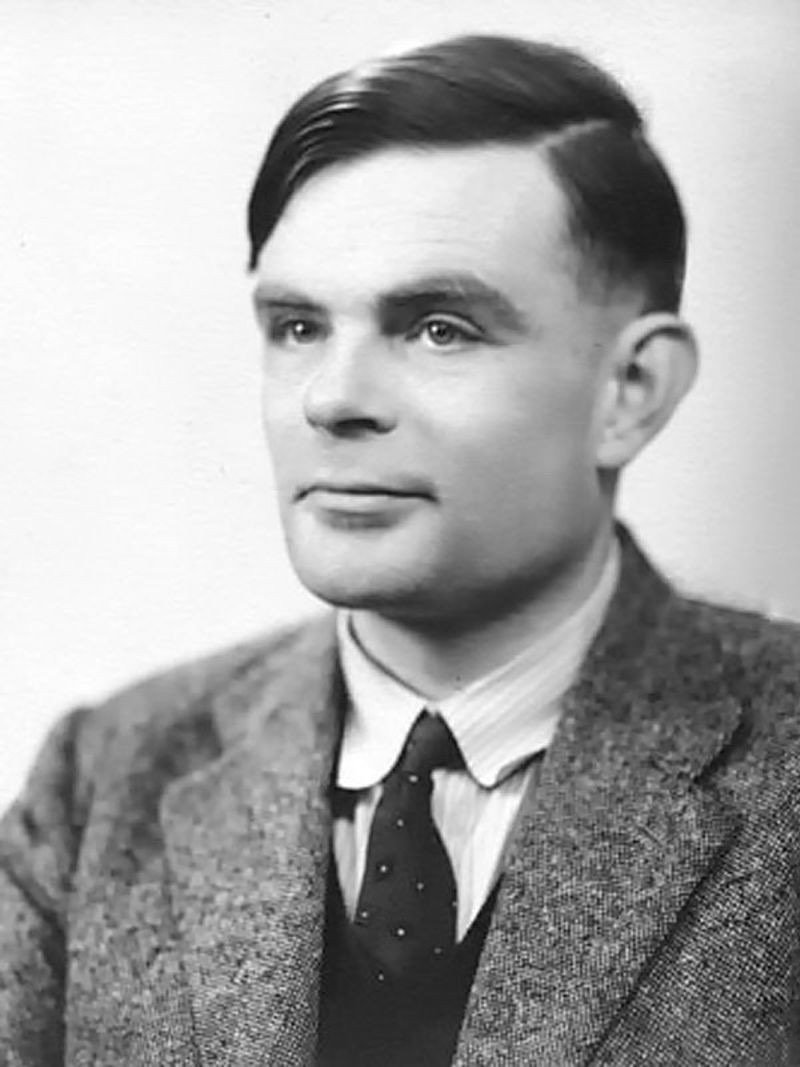
In 1950 the British mathematician Alan Turing published "Computing Machinery and Intelligence" in the journal Mind. It opens with the question "Can machines think?" Turing argued the question was too vague, so he proposed a test instead, which he called the imitation game. If a judge chatting by text cannot reliably tell a machine from a person, he suggested, we should treat the machine as thinking. It is now known as the Turing test.
The field got its name a few years later. In 1955 John McCarthy, Marvin Minsky, Nathaniel Rochester, and Claude Shannon proposed a summer workshop at Dartmouth College on "artificial intelligence." The workshop ran in the summer of 1956. Its proposal claimed that every aspect of learning could in principle be described precisely enough for a machine to simulate it. That bold bet still drives the field.

Symbolic AI, expert systems, and the AI winters
The first big approach treated thinking as manipulating symbols with rules. In 1956 Allen Newell, Herbert Simon, and Cliff Shaw built the Logic Theorist, a program that proved theorems from Principia Mathematica. In 1966 Joseph Weizenbaum at MIT wrote ELIZA, a simple chatbot that matched patterns in what you typed. People were surprised by how human it felt.
Early researchers expected fast progress, and they were wrong. Programs that worked on toy problems broke on real ones, which were messier and needed vast amounts of common sense. In the 1970s funders lost patience. In Britain, the 1973 Lighthill report criticized the field, and funding was cut. This slump is called the first AI winter.
AI came back in the 1980s with expert systems: programs that stored a specialist's knowledge as hundreds or thousands of "if this, then that" rules. MYCIN at Stanford suggested treatments for blood infections, and XCON helped Digital Equipment Corporation configure computer orders. But the rules were costly to write, hard to update, and failed in cases nobody had foreseen. By the late 1980s the market for these systems had collapsed, and a second AI winter followed.
The other thread: perceptrons to backpropagation (1958-1986)
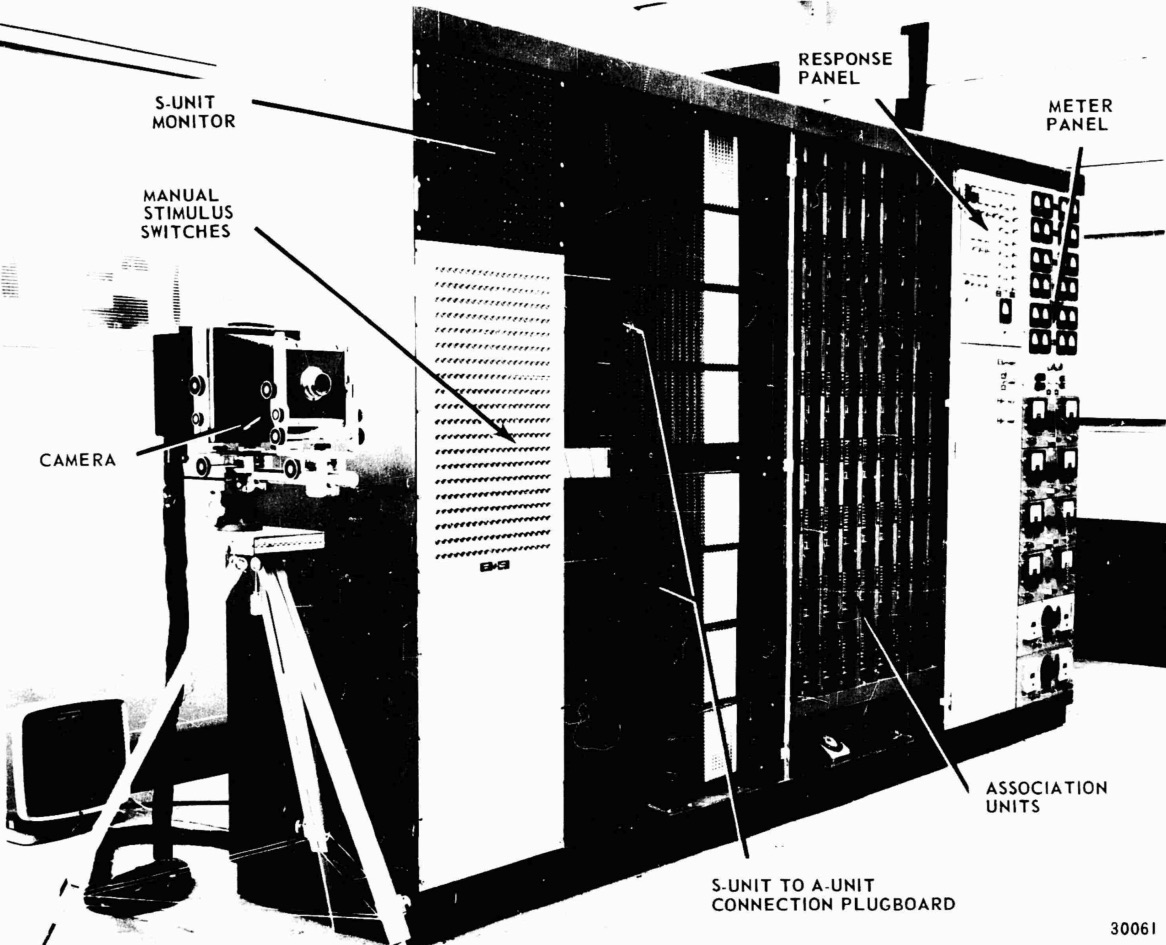
A rival idea ran alongside symbolic AI: copy the brain. In 1958 the psychologist Frank Rosenblatt described the perceptron, a model of a neuron that adds up weighted inputs and fires if the total passes a threshold. Crucially, it could learn. When it guessed wrong, it adjusted its weights. Rosenblatt's team built it as a machine, the Mark I Perceptron, which learned to recognize simple shapes from a grid of light sensors.
In 1969 Marvin Minsky and Seymour Papert published Perceptrons, a book showing that a single layer of these units cannot learn some simple patterns. Networks with more layers could, but nobody had a good way to train them. Interest and funding faded for years.
The fix was backpropagation. In 1986 David Rumelhart, Geoffrey Hinton, and Ronald Williams showed in Nature how to train multi-layer networks: measure the error at the output, then pass it backward through the layers to work out how much each weight should change. The idea had earlier roots, but this paper made it widely used. In the late 1980s Yann LeCun used it to train networks that read handwritten digits, and banks later used similar systems to read checks.

From Deep Blue to the deep learning breakthrough (1997-2012)
In May 1997 IBM's Deep Blue beat world chess champion Garry Kasparov in a six-game match. It was a landmark, but Deep Blue did not learn the way modern AI does. It searched through millions of positions per second and scored them with rules tuned by people and grandmasters.
Through the 1990s and 2000s, machine learning quietly took over practical problems. Spam filters, search ranking, and product recommendations learned from data instead of hand-written rules. Two things were piling up in the background: far more digital data, and far faster chips, especially graphics processing units (GPUs) built for video games.
They came together in the ImageNet challenge. Fei-Fei Li and her colleagues built ImageNet, a large set of labeled photos, and from 2010 ran a yearly contest on more than a million images in 1,000 categories. In 2012 a deep neural network called AlexNet, from Alex Krizhevsky, Ilya Sutskever, and Geoffrey Hinton, trained on two GPUs and cut the winning error rate sharply. Within a few years nearly every top entry was a deep network, and the error kept falling.
ImageNet challenge: winning top-5 error rate
| Top-5 error | |
|---|---|
| 2010 | 28.2% |
| 2011 | 25.8% |
| 2012 AlexNet | 16.4% |
| 2013 | 11.7% |
| 2014 GoogLeNet | 6.7% |
| 2015 ResNet | 3.57% |
AlphaGo, the Transformer, and the road to ChatGPT (2016-2022)
In March 2016 DeepMind's AlphaGo beat Lee Sedol, one of the world's best Go players, four games to one. Go has far too many possible positions to search the way Deep Blue searched chess. AlphaGo combined deep neural networks with reinforcement learning, first learning from human games and then improving by playing against itself.
In 2017 a team at Google published "Attention Is All You Need," which introduced the Transformer. Its key idea, attention, lets each word in a passage look at every other word to work out what it means in context. Transformers also train well in parallel on many chips, so they could be scaled up to far more data than older designs.
OpenAI used Transformers for its GPT models. GPT-3, in 2020, had 175 billion parameters and could write essays, answer questions, and follow examples given in the prompt. Then on November 30, 2022, OpenAI released ChatGPT, a chat interface on a model tuned to follow instructions. It passed a million users within its first week and made LLMs a household topic.
Where AI is now
Since 2023 the major labs have released models that can work with images and audio as well as text, and that can use tools such as web search and code. When a model plans and carries out several steps toward a goal by itself, people call it an agent. How reliable agents are on real work is still an open question, and it changes quickly, so check current sources before trusting any claim about what a given product can do.
The field's pioneers have been widely honored. Yoshua Bengio, Geoffrey Hinton, and Yann LeCun shared the 2018 Turing Award for deep learning. In 2024 John Hopfield and Hinton won the Nobel Prize in Physics for early work on neural networks, and Demis Hassabis and John Jumper shared the Nobel Prize in Chemistry for AlphaFold, which predicts the shapes of proteins.
Seven turning points in AI
- 1950: Turing test: Alan Turing asks "Can machines think?" and proposes the imitation game.
- 1956: AI is named: The Dartmouth workshop launches artificial intelligence as a field.
- 1986: Backprop: Rumelhart, Hinton, and Williams show how to train multi-layer neural networks.
- 1997: Deep Blue: IBM's chess computer beats world champion Garry Kasparov.
- 2012: AlexNet: A deep network trained on GPUs wins the ImageNet challenge by a wide margin.
- 2017: Transformer: "Attention Is All You Need" introduces the design behind modern LLMs.
- 2022: ChatGPT: OpenAI releases ChatGPT, and LLMs reach the general public.
The big split: symbolic AI versus connectionism
The oldest argument in AI is about where intelligence comes from. Symbolic AI, sometimes called GOFAI for "good old-fashioned AI," says intelligence is reasoning with explicit symbols and rules. You write down facts and logic, and the program draws conclusions. Its strength is that you can read and check every step.
Connectionism says intelligence emerges from many simple units, like neurons, whose connection strengths are learned from experience. Nobody writes the rules. Its strength is handling messy input like photos and speech. Its weakness is that the knowledge is spread across millions or billions of numbers, so it is hard to explain why the system did what it did.
Today's LLMs are a connectionist triumph, but the debate is not over. Critics such as the cognitive scientist Gary Marcus argue that pure neural networks still make basic reasoning errors and need some symbolic structure. Many researchers now work on hybrids, such as language models that call a calculator or write code to solve a problem exactly.
Two ways to build intelligence
| Symbolic AI | Connectionism | |
|---|---|---|
| Where knowledge comes from | Rules written by people | Learned from examples |
| Strength | Clear, checkable steps | Handles images, speech, text |
| Weakness | Brittle with messy input | Hard to explain its choices |
| Example | Expert systems, Deep Blue | AlexNet, ChatGPT |
| Heyday | 1956 to late 1980s | 2012 to today |
Both date back to the 1950s · Modern hybrids mix the two
The five tribes, plus reinforcement learning
In his 2015 book The Master Algorithm, the computer scientist Pedro Domingos sorted machine learning into five "tribes," each with its own favorite method. Symbolists learn rules by logic. Connectionists train neural networks with backpropagation. Bayesians treat learning as updating probabilities as evidence comes in, and spam filters are a classic Bayesian success. Evolutionaries breed better programs through mutation and selection, an idea pioneered by John Holland. Analogizers decide by finding the most similar past cases, as in support vector machines.
Domingos argued that a single "master algorithm" would one day combine all five. Whether or not that happens, the framing is a useful map: each tribe is good at different problems, and many real systems borrow from several.
Reinforcement learning is a further approach that cuts across these tribes. An agent tries actions, gets rewards or penalties, and learns which choices pay off over time. Richard Sutton and Andrew Barto laid its foundations and won the 2024 Turing Award for it. AlphaGo used it, and so does the step that tunes chatbots on human feedback.
How a modern AI model works, in plain words
Start with data. An LLM is trained on a huge collection of text from books, websites, and code. The text is cut into tokens, which are often whole words or pieces of words.
The model itself is a neural network with billions of parameters, numbers that control how strongly each part responds to each input. At first the parameters are random, and the model's guesses are nonsense. Training is a loop. The model reads some text and predicts the next token. Its guess is compared with the real next token, and the error is measured. Backpropagation then works out how to nudge every parameter so the right answer becomes a little more likely. Repeat this billions of times, and the model gets very good at continuing text.
To predict the next word well across so much text, a model has to pick up grammar, facts, and patterns of reasoning. But it is still guessing what text is likely, not looking facts up. That is why LLMs sometimes state wrong things confidently, which people call hallucination.
A model that only predicts text is not yet a helpful assistant. So it is fine-tuned on examples of good answers to instructions. Then comes reinforcement learning from human feedback (RLHF): people rank several answers, a second model learns their preferences, and the main model is tuned to give answers people prefer. OpenAI's 2022 InstructGPT paper described this recipe, which ChatGPT built on.
The training loop
- Read a chunk of text: The model takes in a sequence of tokens from its training data.
- Predict the next token: Using its current parameters, it guesses what comes next.
- Measure the error: The guess is compared with the real next token to get a loss score.
- Nudge the parameters: Backpropagation adjusts every parameter slightly to make the right answer more likely.
The big debates: scaling, safety, bias, and jobs
Scaling. In 2020 OpenAI researchers reported that language models improve in a smooth, predictable way as you add parameters, data, and computing power. In his 2019 essay "The Bitter Lesson," Richard Sutton argued that general methods that use more computation tend to beat clever hand-built knowledge in the long run. Others, including Yann LeCun, argue that text prediction alone will not lead to systems that truly understand the physical world.
Safety and alignment. Alignment means making AI systems reliably do what their designers and users intend. In 2023 Geoffrey Hinton left Google to speak more freely about AI risks, and hundreds of researchers signed a short statement that reducing the risk of extinction from AI should be a global priority. Other researchers think such fears distract from present harms.
Bias. Models learn from human data, so they can copy its unfairness. In the 2018 Gender Shades study, Joy Buolamwini and Timnit Gebru found that commercial face analysis tools got the gender of darker-skinned women wrong far more often than that of lighter-skinned men.
Jobs. A 2023 study by OpenAI and University of Pennsylvania researchers estimated that most U.S. workers have at least some tasks that language models could speed up. Whether that mostly replaces jobs or changes them is still argued, and the answer will likely differ by job.
How to learn AI, step by step
Step 1: use the tools every day. Ask a chatbot to explain something you know well, and check where it goes wrong. You will build a feel for its strengths and failure modes faster than any book can teach.
Step 2: learn the core ideas. You should be able to explain, in your own words, training data, parameters, the training loop, next-token prediction, fine-tuning, and why models hallucinate. Andrej Karpathy's talks and 3Blue1Brown's videos on neural networks are good free starting points. Russell and Norvig's Artificial Intelligence: A Modern Approach is the standard textbook for the wider field.
Step 3: if you want to go technical, learn some Python and basic linear algebra (vectors and matrices), plus a little calculus and probability. You do not need all of it before starting. Learn each piece when a project needs it.
Step 4: build a small project. Train a simple image classifier on handwritten digits, or write a script that uses an LLM to sort your notes. Finishing something small teaches more than reading about something large.
Wondering can turn any of these topics into a course of 3-minute lessons that you can watch, listen to, or read. Each lesson ends with practice questions, spaced review brings ideas back before you forget them, and a voice tutor lets you check your understanding out loud. It is free to start. A good first course is a lesson series based on Andrej Karpathy's deep dive into LLMs like ChatGPT.
Wondering also makes polished courses and polished lessons on AI, such as How AI Actually Works, so you can start with a ready-made course instead of building one. It is one place to learn AI, use it better at work, and follow your other interests too.
Try a free lesson on how LLMs like ChatGPT work
Common misconceptions to drop early
"AI is one thing." It is a field with many methods. A recommendation engine, a chess program, and a chatbot are all AI, built in different ways.
"The model looks things up." A plain LLM generates likely text from patterns learned in training. Some products add a search step, but the model itself is not a database, so verify facts that matter.
"It thinks like a person." LLMs can do impressive reasoning on some tasks and fail at easy ones that people find trivial. Judge them by testing, not by how fluent they sound.
"AI is brand new." The core ideas are decades old. What changed after 2012 was the amount of data and computing power, which let old ideas like neural networks work at scale.
Read how to learn AI for your job
Questions
What is the difference between AI and machine learning?
AI is the broad goal of making computers do intelligent tasks. Machine learning is one way to get there, where the system learns patterns from data instead of following rules people wrote. Most AI today is machine learning.
Who is the father of artificial intelligence?
Alan Turing is often called a father of AI for his 1950 paper asking whether machines can think. John McCarthy coined the term "artificial intelligence" for the 1956 Dartmouth workshop, and he is also given that title.
What were the AI winters?
They were periods when funding and interest in AI dropped after early promises went unmet. The first came in the 1970s, and the second followed the collapse of the expert systems market in the late 1980s.
How does ChatGPT work?
ChatGPT runs on a large language model, a neural network trained on huge amounts of text to predict the next token. It was then fine-tuned on example answers and on human feedback so that it follows instructions and gives answers people prefer.
Do I need math to learn AI?
Not to understand and use it well. To build models yourself, you will want Python, basic linear algebra, and some probability and calculus, which you can learn as your projects need them.
What is the best way to start learning AI?
Use AI tools daily, learn the core ideas such as training data, parameters, and next-token prediction, and then build a small project. Short daily lessons with practice, like those on Wondering, help the ideas stick.
References
- Turing, A. M. (1950). Computing machinery and intelligence. Mind, 59(236), 433-460.
- McCarthy, J., Minsky, M. L., Rochester, N., and Shannon, C. E. (1955). A proposal for the Dartmouth summer research project on artificial intelligence.
- Rosenblatt, F. (1958). The perceptron: A probabilistic model for information storage and organization in the brain. Psychological Review, 65(6), 386-408.
- Rumelhart, D. E., Hinton, G. E., and Williams, R. J. (1986). Learning representations by back-propagating errors. Nature, 323, 533-536.
- Russakovsky, O., Deng, J., Su, H., et al. (2015). ImageNet Large Scale Visual Recognition Challenge. International Journal of Computer Vision, 115, 211-252.
- He, K., Zhang, X., Ren, S., and Sun, J. (2015). Deep residual learning for image recognition. arXiv:1512.03385.
- Silver, D., Huang, A., Maddison, C. J., et al. (2016). Mastering the game of Go with deep neural networks and tree search. Nature, 529, 484-489.
- Vaswani, A., Shazeer, N., Parmar, N., et al. (2017). Attention is all you need. arXiv:1706.03762.
- Brown, T. B., Mann, B., Ryder, N., et al. (2020). Language models are few-shot learners. arXiv:2005.14165.
- Ouyang, L., Wu, J., Jiang, X., et al. (2022). Training language models to follow instructions with human feedback. arXiv:2203.02155.